Passage to Oud Haerlem
In the past, the village of Heemskerk boasted no fewer than 10 castles, as it was historically a base for the nobility of Holland. According to legend, a network of tunnels runs beneath these castles, with the village church serving as the hub or 'central station' due to its central location.
Among all the castles that once stood in Heemskerk, 'Oud Haerlem' is perhaps the most evocative. The fortress of the knight Simon van Haerlem had stood for only about 100 years before it was razed to the ground in 1351 by the army of Count William V. It was not until 1938—around the time the first airplanes began flying over the area—that the outlines of the castle were rediscovered in a meadow southeast of what was then the village.
During archaeological excavations at the Oud Haerlem site between 1960 and 1965, three keys were discovered (alongside a rare hoard of bronze items, including bowls, pots, and pans). Unfortunately, the purpose of these keys remains a mystery.
While no castle ever stood on the site of the current artwork in the old center of Heemskerk, historical research and archaeological excavations have revealed a long and rich history. To the east of the village church, just outside the existing church wall, a 12th-century well was unearthed. Furthermore, old maps indicate that the church was once part of a larger religious complex. On the other side of the church—where the Burgemeester Nielen Square is located today—the Order of Saint John is believed to have had an establishment. In 1960, an underground vaulted chamber was discovered beneath the bakery that once stood on that spot. This breathed new life into the rumors about the network of tunnels. Perhaps even more intriguing is the stone staircase hidden beneath the gravestone of Jan Deutz—Lord of Heemskerk and a former resident of Assumburg Castle—located behind the village church.
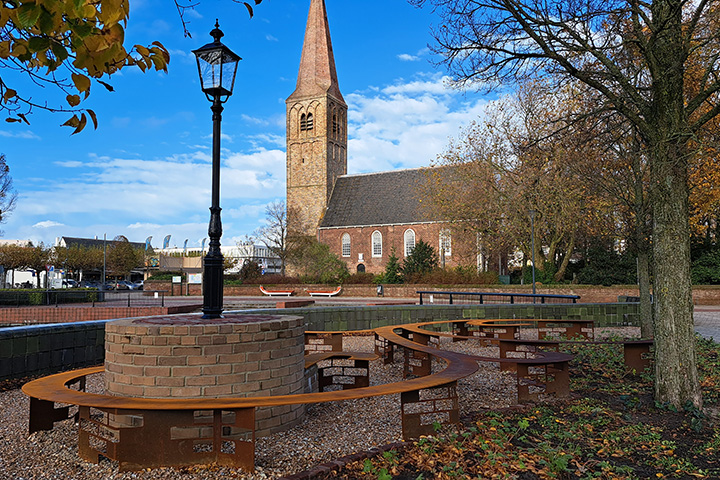
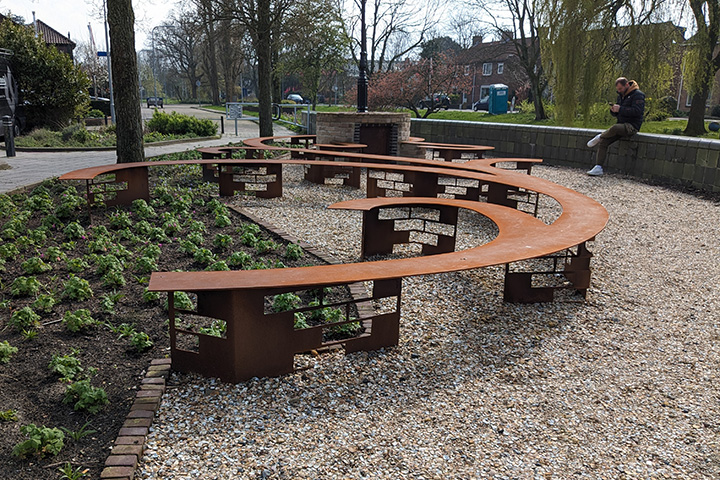
A bench shaped like a fleur-de-lis, originating from the gardens of Assumburg Castle, leads toward a stone well. The well conceals a hatch, adorned with the seal of the knight Simon van Haerlem. A key is inserted into the keyhole, attached to a ring holding two other keys—the very same keys that were discovered in a meadow back in the 1960s. Could this be the entrance to the subterranean passage leading to the former castle?
André Pielage | Singel 116, 3112 GT Schiedam | 06 - 13 95 80 75